


A yellow spring is the lightest option on our reformers. That does not make it the easiest choice for every exercise. Sometimes, taking resistance away leaves you with more work to do.
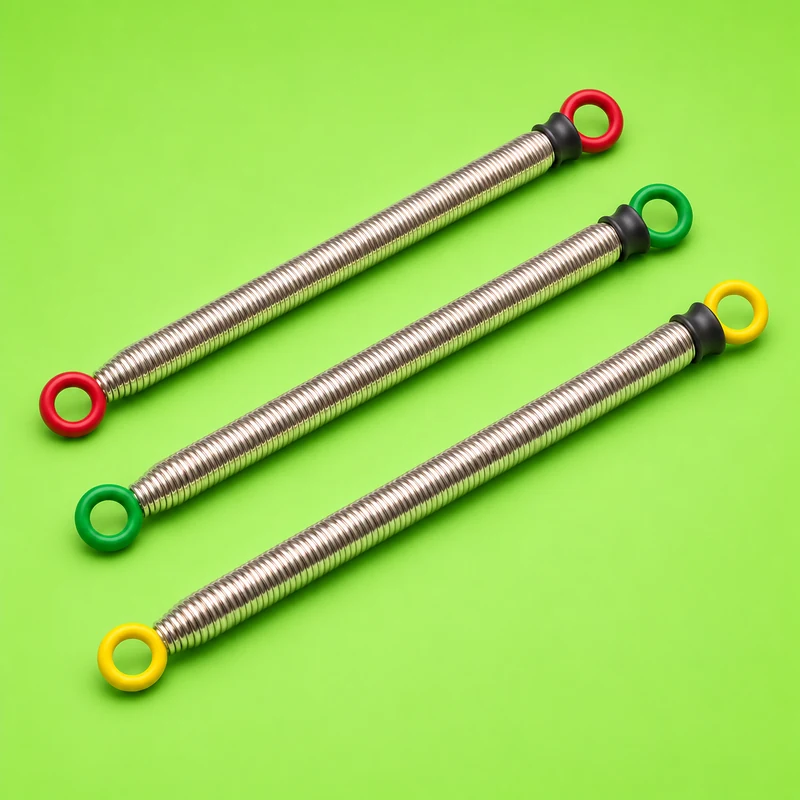
At Springbom, each reformer has six springs, with two yellow, two green and two red. Their colors identify light, medium and heavy resistance. Understanding what those springs do helps you make sense of the setup your instructor calls out.
The three colors on our reformers
- Yellow springs provide light resistance.
- Green springs provide medium resistance.
- Red springs provide heavy resistance.
This is the color system used on our studio’s machines. It is worth checking when you visit another studio, because manufacturers can use different markings. A color you recognize elsewhere may represent a different resistance level.
Similar size, a different response
Our reformers use German-made springs. They share a similar slender shape, with the color marking identifying the resistance category. The difference is in how the spring responds to being stretched, rather than a large change in its overall size.
Spring construction, including the wire and coil dimensions and the tension built into it, affects that response. Spring rate describes how much additional force is needed to stretch a spring farther. Within our spring range, a red spring provides more resistance than a green or yellow one at a comparable extension.
Six springs and three attachment positions
With two springs in each resistance category, your instructor can combine them to adjust the total resistance. Engaging additional springs increases the combined pulling force for the same carriage position. You are working with a selected combination, rather than one color acting alone.
Our machines also have three attachment positions, providing another way to adjust the resistance. Which springs are engaged, their attachment position and how far they stretch all contribute to the setup. Follow the instructor’s cue for the current exercise instead of carrying the previous setting into the next movement.
Where the springs connect
The springs run lengthwise beneath the carriage toward the footbar end of the reformer. One end connects to an anchor under the moving carriage. The other engages the springbar on the frame. As the carriage moves away from that end, the engaged springs lengthen and pull it back toward the starting position.
At the adjustment end, a closed colored eye sits beyond a black collar. The eye fits over a retaining peg on the springbar. Both ends of each spring have closed eyes.
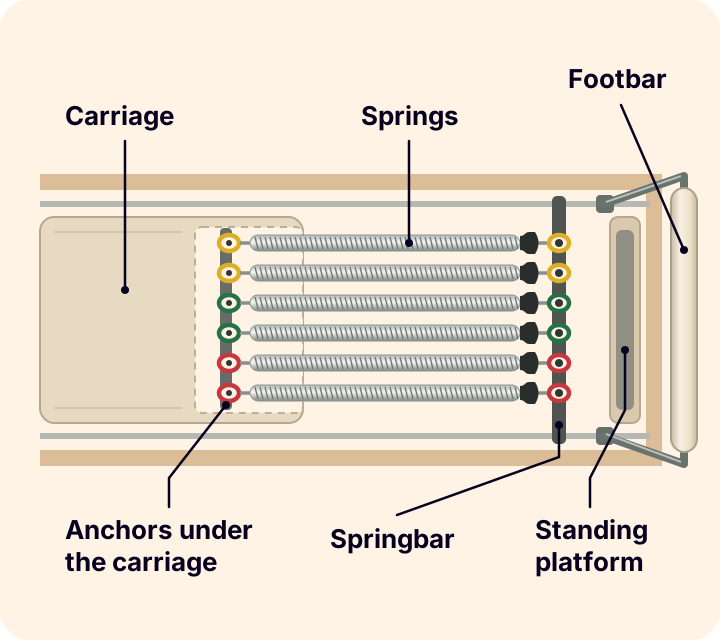
The springbar holds the selected springs. The footbar is the raised bar you may press against during an exercise. Between them is the standing platform, a small fixed surface at the foot end. Unlike the carriage, this platform does not slide.
More resistance and more difficulty are different
During a leg press against the footbar, heavier resistance gives you more to push against. In an exercise that asks you to keep the carriage steady, spring tension can help restrain its movement. Reduce that support and more of the control may be left to you.
That is why yellow is not automatically the easiest option for every exercise, and red is not automatically the most advanced. Our priority is smooth, controlled carriage movement with resistance and support suited to the task. Keep changes under your instructor’s guidance.
On your next visit, listen for the full setup cue. If the carriage feels difficult to keep steady, tell the instructor and ask what the spring is helping you do. You can then understand the setting in relation to your movement, rather than comparing colors with the person beside you.